
Printed meeting packs
Replacement sheets or annotations can become detached from the file that was reviewed and agreed.
When the paper trail becomes the problem
Two versions of the same contract were circulating without a clear history of changes
Recreated workplace scenario. The people, company and documents shown are fictional

02 / THE DISCOVERY
The meeting had been moving through a familiar agenda: delivery milestones, agreed responsibilities and the wording of an ordinary commercial contract. Then a closed folder was placed between the attendees.

Inside was a printed agreement that looked familiar. Its title, layout and most of its pages matched a copy already open on a laptop. Yet one clause carried different wording. Both copies appeared ready for use, and neither made the approval stage clear.
One colleague checked an email attachment. Another opened the shared folder. A third reviewed the copy brought to the meeting. Which of the two versions was the approved agreement? Nobody could establish that from the documents alone.
Two readable contracts. No dependable way to identify the authorised edition.
NEXT / THE COMPARISON
The contents of this folder raised several questions
Page by page, the difference was visible. What the room could not see was who had amended the wording, which review followed or whether the older copy had been superseded.
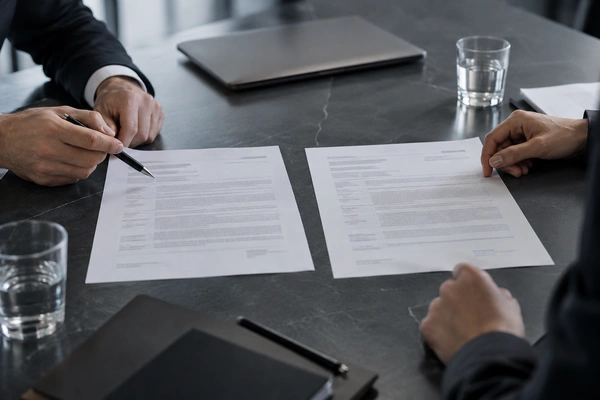
Matches the planned discussion; an independent approval date is not available from the copy.
Contains different wording; the associated review and authorisation steps cannot be reconstructed.
Which version can be connected to a review, an approval and a defined point in time?
Illustrative comparison. No real contracts, signatures or personal information are shown.
03 / THE MISSING HISTORY
The difference in the clause was visible. The chain of events behind it was not. An email timestamp showed when one attachment was sent, but not necessarily when its contents were approved. A filename suggested a sequence without proving it.
Without a clear record of revisions, reviewers and approvals, the meeting could not establish whether one edition replaced the other. Retrieving a document was not the same as knowing its standing.
Revision → reviewer → approval decision → current record

THEN / THE EXPOSURE
Paper and electronic copies serve different day-to-day needs. Without shared document controls, each additional location can carry an older edition beyond the point at which it should be relied upon.
Replacement sheets or annotations can become detached from the file that was reviewed and agreed.
A message preserves a copy at one moment, not necessarily the latest authorised version of the contract.
Near-identical filenames can circulate without an obvious connection to the review or decision that produced them.
04 / DIGITAL ARCHIVING
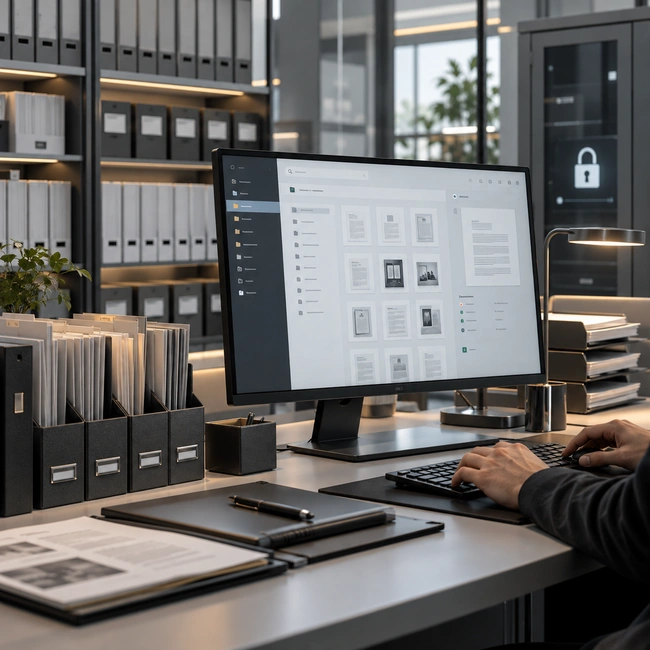
Digital archiving brings business documents into a managed environment with searchable records, defined retention arrangements and an organised approach to revisions. The goal is not merely to scan paper or move a file into another folder.
For legal and administrative teams, a useful archive makes it easier to identify the record in question and examine the information associated with it. The document, its history and the roles permitted to handle it belong in a coherent workflow rather than isolated locations.
Find a document within its record.
Review relevant changes and actions.
Control how records are handled.
05 / THE CONTROL LAYER
Once documents are archived, three complementary controls help teams understand what happened, whether the stored record has changed and who is permitted to act.
An activity log can connect a document to recorded events such as capture, review and changes. It gives a legal or administrative team evidence to examine when reconstructing a sequence of work, instead of relying on memory or the latest email thread.
Illustrative steps; audit records depend on the configured workflow.
Integrity measures and version information can help distinguish the intended stored record from later changes or parallel copies. The recorded relationship between versions should support an organisation’s approval and retention rules, rather than replace them.
No technical control removes every operational or security risk.
Viewing, revising and approving a document are different responsibilities. Role-based permissions help organisations distinguish those actions, allowing authorised collaboration while reducing ambiguity over who can alter a record.
Available roles and access settings vary by implementation.
These are document-control requirements to investigate. Product features, configuration and suitability should be confirmed directly with the supplier.
06 / THE PRODUCT
The meeting’s difficulty was not a dramatic revelation. It was the ordinary uncertainty created by two plausible versions with no dependable approval trail. Digital document management is one way organisations can address that operational gap.
When evaluating a product, legal and administrative teams can ask about version records, the visibility of document activity and permission settings for people with different responsibilities.
Margin Register is published by Logic Document Archiving Limited. DocuWare is an independent software provider, and this website is not operated by DocuWare.
PRODUCT SPOTLIGHT
Document management and digital archiving software intended to help organisations organise business records, track relevant document activity and manage permissions.
See the official supplier website for current capabilities and implementation requirements.
07 / REQUEST A DEMONSTRATION
Ask how document versions are related, which actions can be traced and how access permissions would work for your organisation’s review and approval process.
Demonstrations, product features and commercial terms are provided by DocuWare. The link opens DocuWare’s official website.